


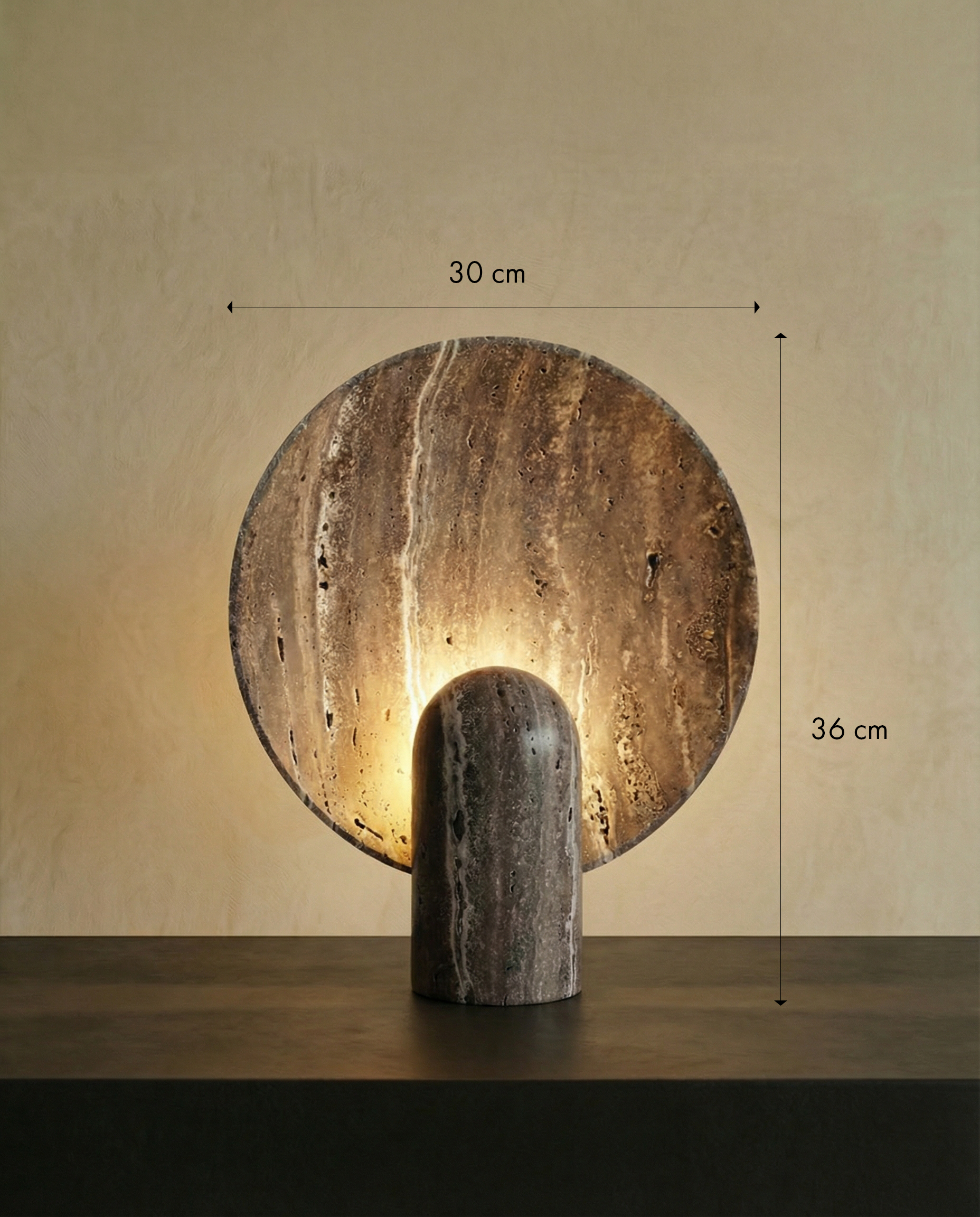
Before the light comes on, the Cairon is already worth looking at. A disc of travertine, 30cm across, its surface veined and pitted and alive with the geology of its own formation, standing upright on a smaller cylinder of the same stone. When the light comes on, what was already beautiful becomes extraordinary.
The light source is invisible. Hidden behind the cylinder base, it rises upward and spreads across the face of the disc from below, illuminating the travertine from within its own shadow, revealing veins and channels and natural voids that daylight never reaches. The disc does not glow evenly. It glows as the stone decides, brighter where the stone is thinner, darker where it thickens, the linear veining becoming a vertical landscape of warm light that shifts with every viewing angle and every hour of the day.
No hardware is visible. No cable interrupts the surface. The disc and the cylinder are the same material, the same finish, the same piece of stone's history, a composition of such material unity that the lamp becomes, in the truest sense, a single object rather than an assembly of components.
Unlit, it is a sculpture. Lit, it is a light source that makes the room around it feel as though it was built for exactly this object, in exactly this position, on exactly this surface. The Cairon is the table lamp for people who understand that the best lighting is the kind that makes you forget you turned it on.
 View Testimonial →