


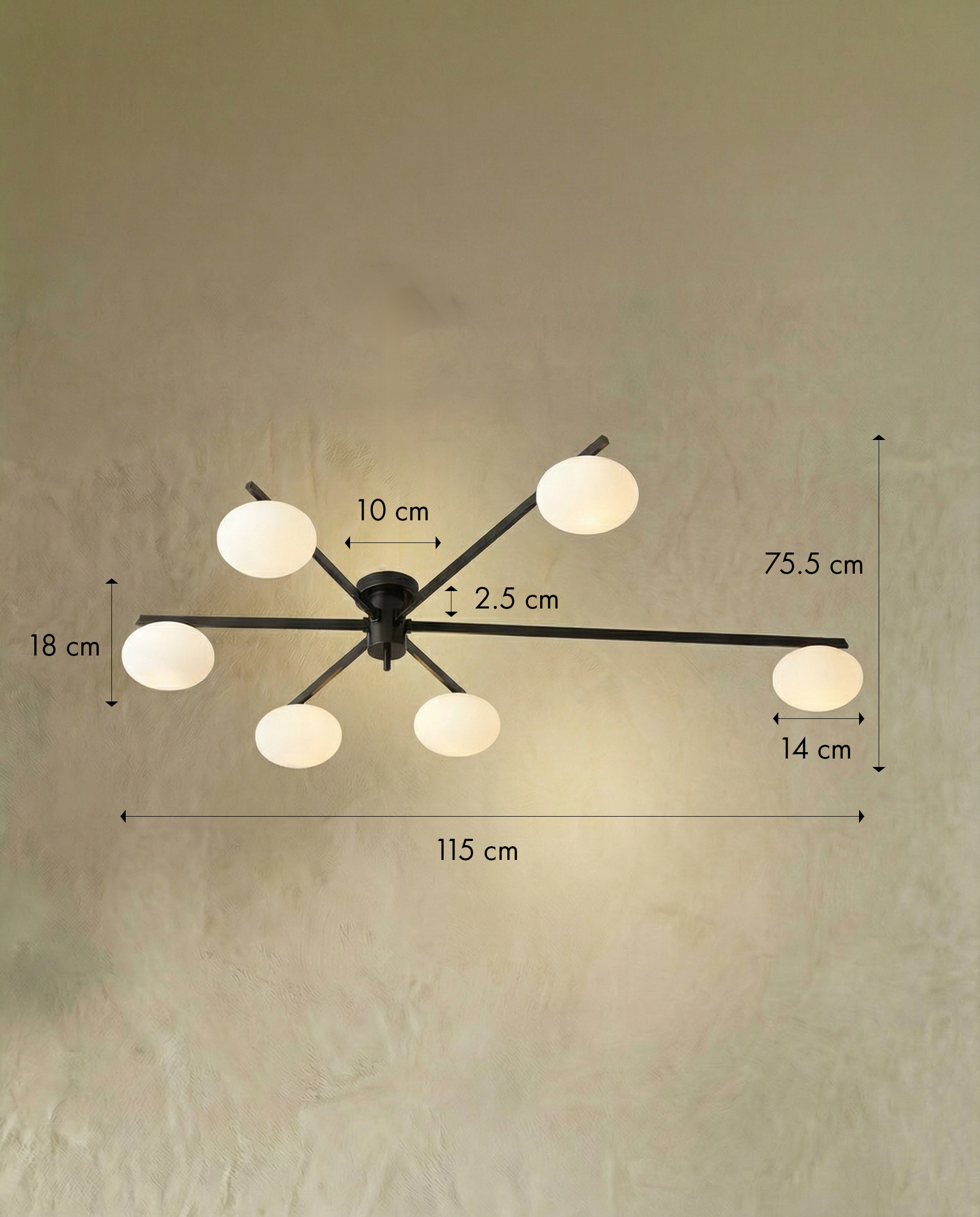
Six arms reach outward from a single matte black hub, no two the same length, no two at the same angle, each one ending in an opal globe that glows with a warmth the ceiling amplifies and sends back into the room below. The Orvyn asks nothing of the architecture beneath it. It provides everything the room above it needs.
The asymmetry is the Orvyn's entire argument. A symmetrical six-arm chandelier is furniture. An asymmetrical one, arms at different lengths, different angles, the composition resolved by eye rather than by geometry, is a decision. The Orvyn's six matte black arms radiate from the hub with the logic of something organic: not random, not patterned, but balanced in the way that a well-arranged shelf or a considered vase grouping is balanced. You cannot say why it works. You can only see that it does.
The opal globes are warm and omnidirectional, each one a soft sphere of even light that fills the room below with a warmth that has six sources and no single direction. From directly below, a composition of globes at different radii from the centre. From the side, a ceiling fixture that reads as sculpture. From across the room, through floor-to-ceiling windows, above a round dining table, against a pale plaster wall, something that makes the space it occupies feel entirely resolved.
As a semi-flush mount, the Orvyn opens the range to rooms that lack the ceiling height for a pendant chandelier, the apartments, the hotel suites, the contemporary dining rooms where the ceiling is the constraint and the statement still needs to be made. It mounts directly to the ceiling rose and extends outward, present, considered, and entirely in command of the space it anchors.
 View Testimonial →