


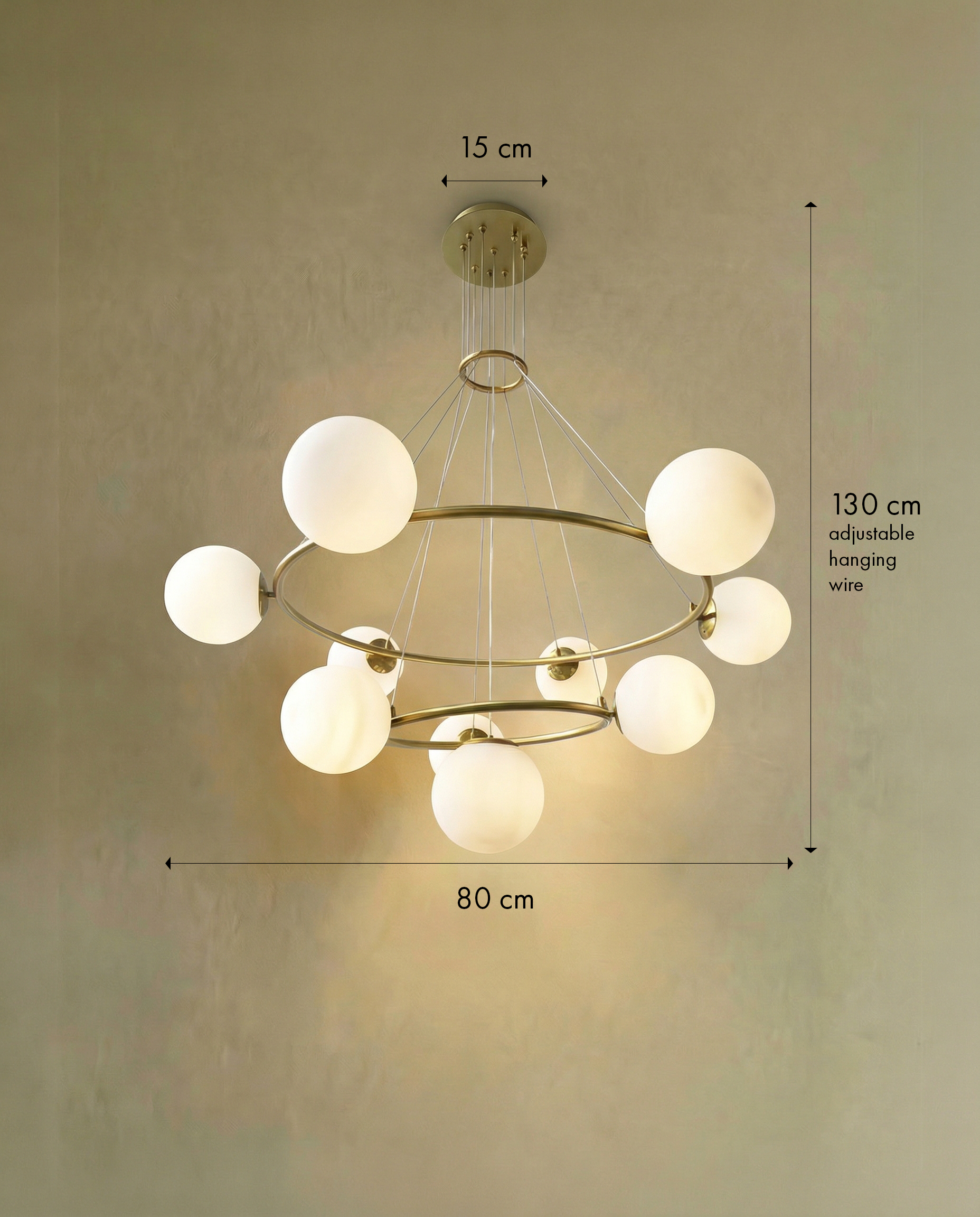
Nine spheres of warm light, each one suspended independently from a brass ring, each one at a slightly different height, the whole composition hanging like a small solar system that has decided a dining room is exactly the right place to be.
The ring is the structure. The globes are the light. Eight frosted opal spheres orbit the brass circle at varying heights, their individual wires converging at a single brass canopy above, the geometry of the suspension creating a cone of fine lines that is part of the composition rather than merely the means of hanging it. Below the ring, one larger globe descends alone on its own wire, the anchor of the entire piece, the note that resolves the composition downward.
The opal glass is warm and non-directional, no single globe points anywhere in particular, so the light fills the room entirely, from ceiling to table to wall, in an even warmth that shifts only as the eye moves around the piece. From directly below, a ring of spheres with a single larger one at the centre. From the side, a constellation in slow orbit. From across the room, something that earns its place in a space without needing to announce itself.
At 80cm with a 130cm adjustable drop, the Orvane Ring belongs above grand dining tables, in double-height living rooms, and in hotel lobbies and restaurant dining rooms where a chandelier must be neither too much nor too little, but precisely, unmistakably right.
 View Testimonial →